
Trav's short answer
Yes — if you are a complete beginner, book lessons for your first ski holiday.There is no universal rule saying every first-time skier must take formal lessons, but learning with a qualified instructor is the sensible route. You will usually progress faster, learn safer habits and spend less of the holiday trying to work out basic movements on your own.
Who should book lessons?
For a complete beginner, the answer is straightforward
Start with proper instruction from day one. You need to learn stopping, turning, balance, lift use and basic slope etiquette.
Previous practice is useful, but real pistes, changing snow, longer runs and mountain lifts add a new layer of difficulty.
If you can already stop and link controlled turns, one private session or a suitable group lesson can help rebuild confidence.
Why lessons matter
You are learning control, not just how to slide downhill
Beginners often think the first goal is simply to get moving. In practice, the important skills are controlling speed, stopping where you intend to stop, changing direction and understanding where you should position yourself on a piste.
Group or private?
Choose the lesson format that fits your budget and confidence
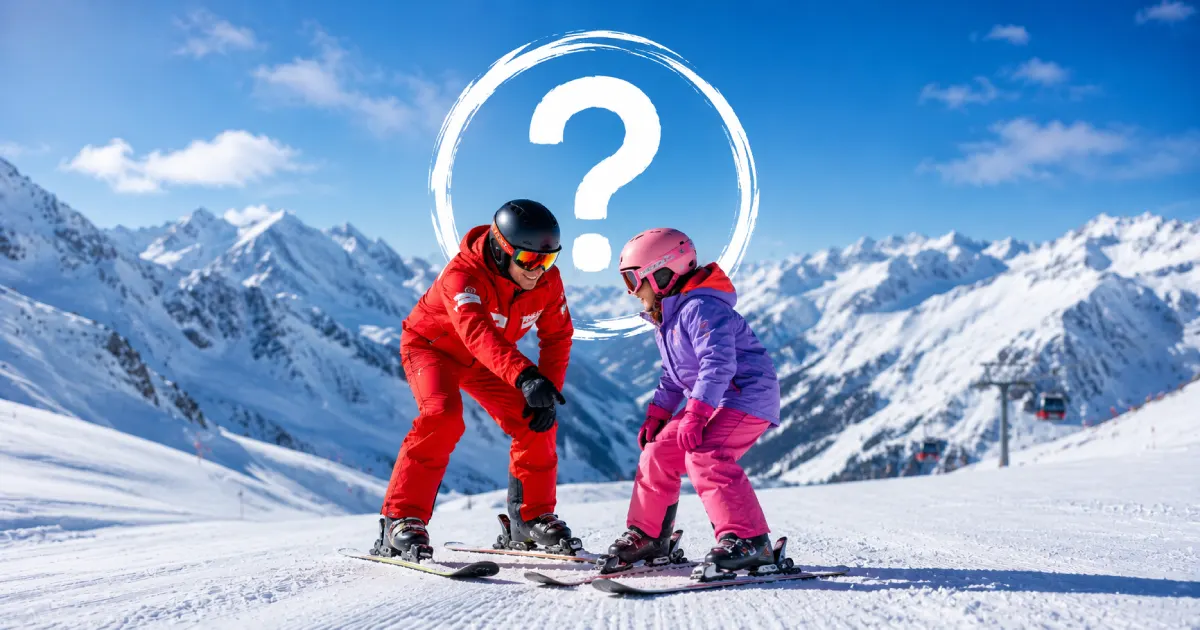
Both formats can work for complete beginners. ESF describes group lessons as level-matched instruction with a social atmosphere, while private lessons are built around your own pace and needs. The better choice depends more on how you learn than on there being one universally superior option.
Group lessons
A strong default for most first-time skiers, especially if you are happy learning alongside people at a similar level.
- Lower cost per person than private instruction in most resorts
- Social and less intense
- Progresses at the pace of the group
- Often available as a multi-day beginner course
Private lessons
Useful if you are nervous, have limited time, are returning after a difficult first experience or want the instructor focused on one person or family.
- Teaching can adapt quickly to your pace
- Easier to focus on a specific problem
- Often more flexible around timing
- Usually costs considerably more per person
How many lessons?
Do not expect one hour to turn a complete beginner into an independent skier
There is no fixed number of lessons that works for everybody. Fitness, confidence, snow conditions and lesson length all affect progress. For a week-long first ski holiday, a multi-day beginner course is a sensible default because each session can build on the previous one.
Do not measure progress by piste colour alone. Being able to get down a run is different from skiing it with consistent speed control and enough confidence to respond to other slope users.
What happens in a first lesson?
The basics come before the chairlift and the big views
Can a friend teach you instead?
A good skier is not automatically a good ski instructor
A friend can be useful company once you have the basics, but using them as your only instructor on day one is usually a poor trade. Experienced skiers often perform movements automatically and may struggle to explain them in a way a beginner can reproduce.
It can also create unnecessary pressure: the beginner feels they are holding the group back, while the experienced skier gives up their own ski time. A qualified instructor lets both people enjoy the holiday on more equal terms afterwards.
Before your first ski holiday
A little preparation can make the first morning much easier
Snowsport England notes that indoor snow centres and dry slopes are suitable places for beginners to get started, while the Ski Club of Great Britain recommends introductory lessons before a mountain trip if that option is available. You do not need to arrive already able to ski, but familiarity with the equipment removes some of the first-day overload.
Trav's final summary
Book the lessons first, then let the skiing get bigger
If this is genuinely your first time on skis, start the holiday with qualified instruction and give yourself more than one short session to learn. Group lessons suit most beginners; private lessons can be worth the extra cost when confidence, time or individual attention matter more. Once you can control speed, stop and turn reliably, independent practice becomes much more useful.