
Trav's short answer
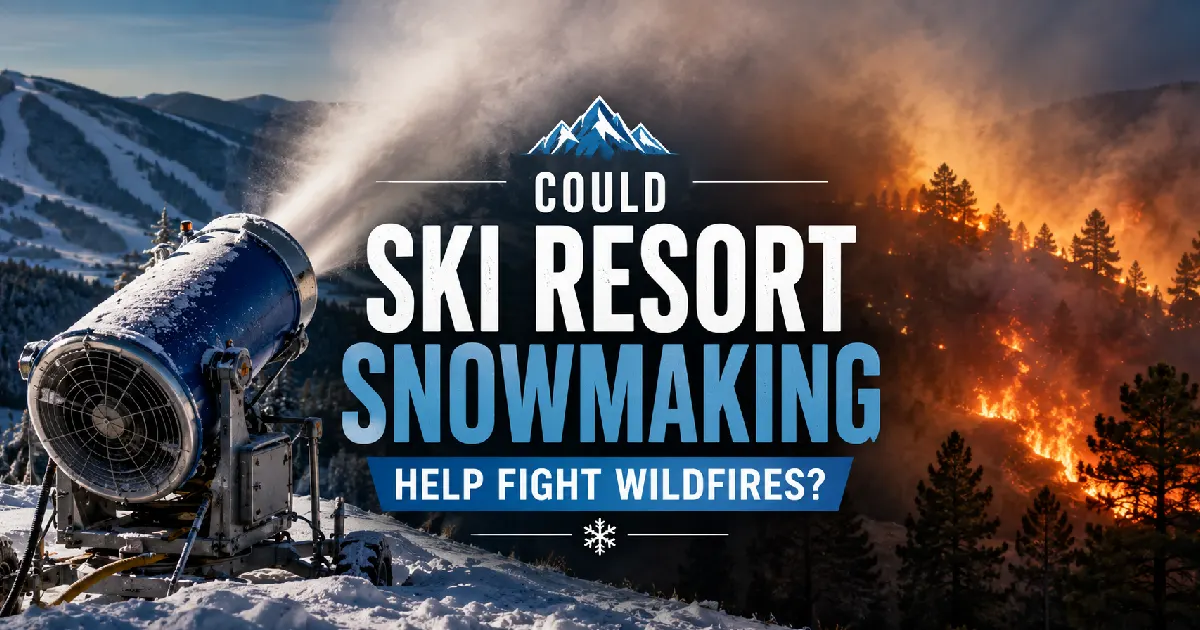
Potentially — but the useful part may be the water network behind the snow guns, not simply firing snow cannons at a forest fire.Adelboden-Lenk in Switzerland is exploring whether reservoirs, underground pipes, pumps and access to stored water could support local firefighting. The idea includes possible water supply points, wetting strategic areas and helping helicopters refill. It is an adaptation concept, not a replacement for professional wildfire equipment or fire crews.
News brief
The story in 30 seconds
Reuters reported on 14 August that fires in Croatia, Germany, France and Greece had forced evacuations in tourist regions. A day earlier, the Associated Press reported that Adelboden-Lenk was exploring whether its snowmaking network could support wildfire response during dry summers.
What happened?
A winter water system is being considered for a summer problem
Adelboden-Lenk's snowmaking network was designed to make technical snow when winter conditions allow. But the infrastructure behind it also means the mountain already contains reservoirs, pumps, underground water pipes and numerous fixed points where water can be moved around the ski area.
According to the Associated Press, resort and local officials are now considering how parts of that network might help during a wildfire. Possible uses include giving fire crews access to water in mountain terrain, wetting selected areas around infrastructure and providing refill opportunities for firefighting helicopters.
How could a ski resort's snowmaking network help?
Think of it as a three-step water system. The resort already stores water, already has pipes across the mountain, and may be able to give emergency crews useful access to that water.
Water is already stored
Snowmaking reservoirs can hold water high on the mountain.
Existing pipes move it
The snowmaking network already carries water around parts of the ski area.
Emergency teams could use it
Depending on the system and the fire plan, that water could support several jobs.
How could snowmaking infrastructure help?
The hidden value is the network already built into the mountain
Modern snowmaking is much more than the visible cannon beside a piste. Water must be stored, pumped and distributed to the right part of the mountain. That means some resorts already have infrastructure that would otherwise be expensive and difficult to install specifically for emergency use.
Reservoirs
Snowmaking reservoirs can hold water high in the ski area. In an emergency, strategically located stored water could reduce the distance firefighters or aircraft need to travel to refill.
Underground pipes
Pipe networks already move large amounts of water around ski slopes. With suitable connections and emergency planning, parts of that network could potentially provide access points closer to threatened terrain.
Targeted wetting
Water could potentially be used to wet selected piste corridors, vegetation or infrastructure where that forms part of an approved fire-management plan. That is different from claiming a snow gun can extinguish a major wildfire by itself.
Helicopter refill support
The AP report specifically raises the possibility that resort water infrastructure could help helicopters refill, potentially giving crews another mountain water source during an incident.
Important distinction: the idea is to make better use of existing water infrastructure. It does not mean ski resorts can simply switch on every snow cannon during a fire and replace specialist firefighting systems.
The reality check
Snowmaking equipment was not designed as a wildfire network
The concept is interesting precisely because much of the infrastructure already exists, but that does not make every snowmaking system automatically useful in a fire. Any dual-purpose design would need to work with local fire services, water managers and emergency planners.
Why this matters now
Europe's wildfire risk is becoming harder for mountain communities to ignore
The immediate news backdrop is severe. Reuters reported on 14 August that wildfires had affected tourist regions across Croatia, Germany, France and Greece. In Croatia, a fast-moving fire around Omiš forced roughly 1,000 people to evacuate and injured dozens. More than 2,000 people were evacuated in western Germany, while France and Greece also faced evacuations.
The longer-term context goes beyond one bad week. Copernicus says Europe is the fastest-warming continent and is warming more than twice as fast as the global average. Its June 2026 climate bulletin reported record heat in western Europe and widespread dry conditions that contributed to wildfire activity.
Snowmaking has traditionally been discussed almost entirely as a way to protect winter skiing from unreliable natural snowfall. Adelboden-Lenk's wildfire discussion points towards a broader question: whether reservoirs, pumps, roads, communications and lift infrastructure can also become part of how Alpine communities prepare for summer climate risks.
What happens next?
The interesting part will be whether the idea becomes standard planning
Adelboden-Lenk is an early example, not proof of a new industry standard. The next step is whether resorts and emergency services can turn the concept into practical protocols, connections and water-management plans that are useful during a real incident.
For skiers, none of this changes the winter experience today. What it may change is how ski areas justify and design infrastructure that increasingly has to operate in a climate with both less reliable snow and greater summer fire risk.

Trav's final summary
The snow cannon is only the visible part of the story
Adelboden-Lenk's idea is credible because ski resorts already move and store large amounts of water across difficult mountain terrain. The useful wildfire role may therefore be reservoirs, pipes and emergency water access rather than snow guns themselves. If the concept works in practice, future snowmaking projects could increasingly be designed with summer resilience as well as winter skiing in mind.