
Trav's short answer
Australia is not about to stop skiing, but its snow season has already changed — and the research says the pressure will intensify.Protect Our Winters Australia's research says snow cover fell by about 30% between 1954 and 2012 and ski-season length has already contracted by 17–28% across most Australian alpine resorts. Harvey and other advocates are now pushing for a coordinated national adaptation plan rather than leaving resorts and communities to respond separately.
What happened?
An Olympic skier has taken Australia's shrinking-winter debate to Parliament
The Australian moguls skier told News.com.au that changing conditions are not an abstract future problem for his sport. He pointed to Perisher's Toppa's Dream moguls course, saying the main domestic event there has been shortened in each of the past four years because rain, high winds and deteriorating snow made the full course unsafe or unsustainable.
This is an important distinction: Harvey's warning is not that Australian skiing disappears next season. It is that the baseline has already shifted, while resorts, athletes and alpine communities are increasingly having to adapt to warmer winters and less dependable natural snow.
The numbers behind the warning
Published research and NSW climate projections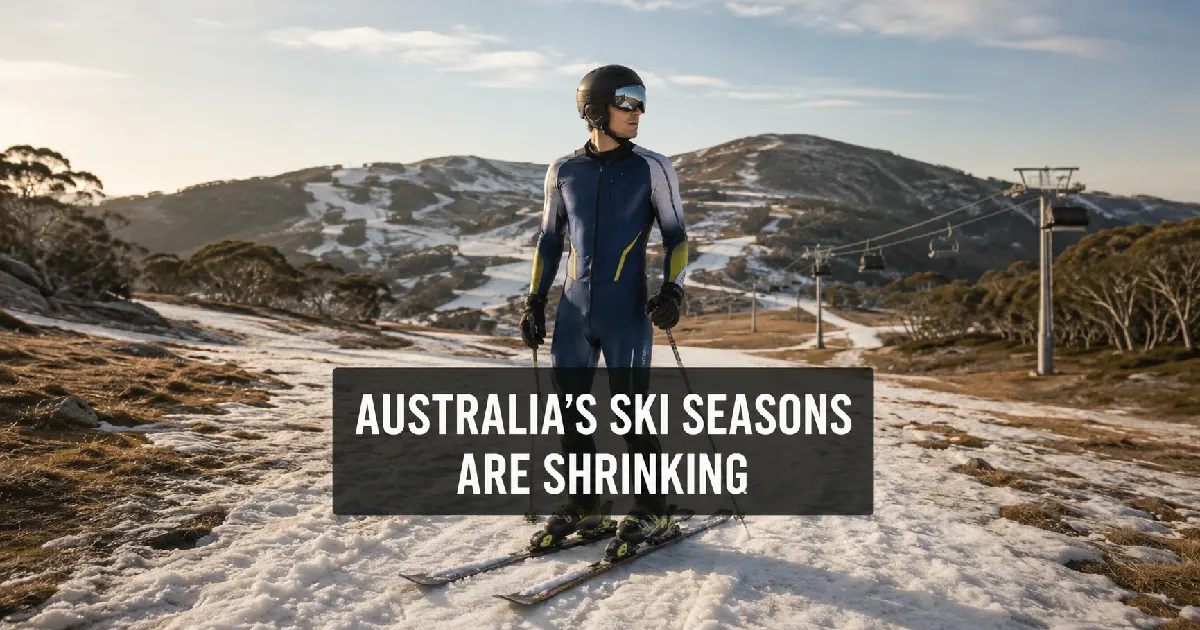
Why Jackson Harvey is speaking out
For an elite moguls skier, the change can show up in the training course itself
Harvey grew up skiing in Colorado before joining the Australian national team. He told News.com.au that one of his strongest Australian skiing memories was training on Toppa's Dream at Perisher during a school exchange in 2015. After later returning with the national team, he noticed that the same course was increasingly affected by rain, high wind and deteriorating snow.
That matters for more than a single race. Moguls courses need enough snow to build and maintain the bumps and jumps safely. When marginal weather damages the course, organisers can shorten it, alter training or cancel parts of a programme. Harvey's argument is that athletes are seeing the same climate pressure that tourism businesses and mountain communities are already dealing with.
The reported four-year pattern at Toppa's Dream is Harvey's account of event conditions. It should not be read as a measure of Perisher's entire ski season or overall resort operations.
Can snowmaking compensate?
Snowmaking helps — but warmer winters also reduce the windows when it works
Artificial snow is already one of the industry's main adaptation tools. It can build a base, repair high-traffic areas and keep important links or beginner terrain open when natural snowfall is limited. That makes snowmaking more important as natural snow becomes less dependable.
But snowmaking still needs sufficiently cold and dry conditions. AdaptNSW projects that suitable snowmaking conditions in the NSW alpine region could decline by about 20% in the near future and by 50–60% in the far future. In other words, the technology designed to compensate for lower natural snowfall is itself exposed to warming temperatures.
Resorts can invest in more efficient equipment, water storage and better slope preparation, but there is a physical limit to how much technical snow can offset warmer conditions. That is why the debate is increasingly about both climate mitigation and adaptation, rather than one piece of resort technology.
What could happen next?
The modelling points to shorter seasons, with the outcome heavily influenced by emissions
The Our Changing Snowscapes project used SkiSim2 modelling across Australian resorts. Protect Our Winters Australia says the average ski season could be around 44 days shorter by 2050 under a mid-emissions pathway and 55 days shorter under a high-emissions pathway.
These are modelled averages, not a prediction that every Australian ski resort loses exactly the same number of days. Altitude, terrain, snowmaking, local climate and operating decisions all affect individual resorts.
What are advocates asking for?
A national alpine adaptation plan is the centre of the current push
Protect Our Winters Australia's position is that adaptation is already happening but too often in separate pieces. Resorts invest in snowmaking and summer tourism, conservation managers protect vulnerable habitats, local communities diversify their economies and governments run their own programmes. The organisation wants those efforts connected by a broader whole-of-Alps strategy.
That argument is consistent with the governance recommendations in Our Changing Snowscapes, which call for more collaboration between governments, resorts, communities, First Nations and natural-resource managers.
What does this mean for skiers?
It is a long-term warning, not a reason to cancel an Australian ski holiday
Australia still has major ski resorts, professional snowmaking and substantial winter tourism. The immediate effect for holidaymakers is more practical: natural snowfall can be less predictable, rain events matter more, and the quality of a week can depend heavily on timing, altitude and snowmaking.
The bigger issue is what happens over decades. Shorter reliable seasons can change when resorts open, how much snow they need to make, which terrain is economical to operate and how heavily mountain towns depend on non-ski activities. Smaller and lower-elevation areas are generally more exposed than the country's highest major resorts.
It also fits a wider trend in ski-resort planning. As we covered in our report on whether snowmaking infrastructure could help with wildfire response, expensive mountain infrastructure is increasingly being discussed as part of broader year-round climate adaptation rather than something used only to run lifts and pistes in winter.

Trav's final summary
The warning is about the direction of travel
Jackson Harvey's Canberra campaign puts an athlete's voice on a trend already visible in the research: Australian snow cover has declined, seasons have shortened and warmer winters will make adaptation harder. Skiing in Australia is not disappearing tomorrow, but the decisions made now about emissions, snowmaking, tourism and Alpine planning will shape how much winter remains dependable in the decades ahead.